Examples & Use Cases
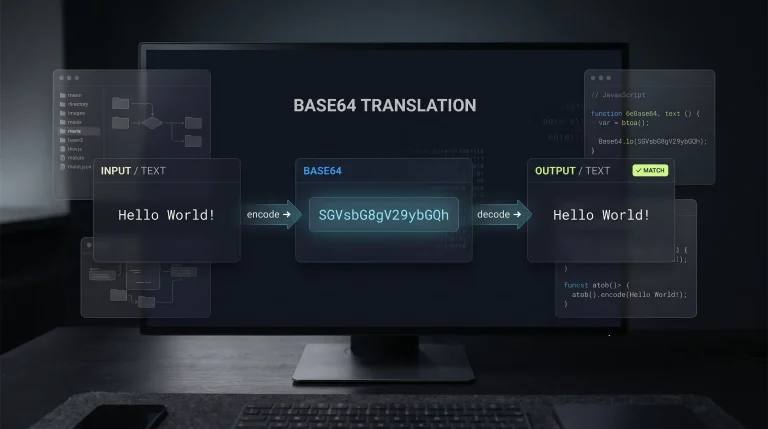
Example 1: Encode Plain Text to Base64
Original text:
Hello World
Base64 output:
SGVsbG8gV29ybGQ=
Enter the original text, select the encoding operation, and convert it to Base64.
Example 2: Decode Base64 to Text
Base64 input:
SGVsbG8gV29ybGQ=
Decoded text:
Hello World
Choose the decoding operation to convert the valid Base64 string back to its original text.
Example 3: Encode International Text and Emojis
Base64 can represent text containing international characters when the text is encoded using a compatible character encoding such as UTF-8.
Example text:
Hello 🌍
UTF-8 Base64 output:
SGVsbG8g8J+MjQ==
This is useful when working with multilingual text, emoji, and other Unicode characters in web applications.
Example 4: Debug API Data
Developers may encounter Base64-encoded values in API responses, request payloads, or application logs. Decoding a valid text-based value can help make the content easier to inspect during troubleshooting.
Example 5: Work With Data URLs
Web applications sometimes use Base64 to represent binary content within data URLs, such as embedded image data. A text-based Base64 encoder can help with compatible text conversions, but encoding arbitrary files or binary data requires a tool that supports those input types.
Example 6: Prepare Text for Development Workflows
Use Base64 encoding when testing applications, preparing sample values, or working with systems that expect text represented in Base64 format. Always confirm the exact format required by the destination system.
Base64 Encoding Tips
Base64 encoding converts data into a text representation; it does not encrypt or authenticate the data.
Valid Base64 input may decode to binary data rather than readable text.
Some Base64 strings omit trailing padding characters, depending on the format and application.
URL-safe Base64 uses different characters from standard Base64 in certain positions.
UTF-8 matters when encoding or decoding text containing international characters and emojis.
Do not assume every Base64 string contains plain text. It may represent an image, document, or other binary data.
Never share passwords, private keys, access tokens, or other sensitive information simply because it has been Base64-encoded.
Who Can Use This Tool?
Web developers working with encoded text and API values.
Backend engineers debugging application data.
Students learning data encoding concepts.
QA testers inspecting text-based payloads.
Technical professionals working with Base64 strings in web development and software integrations.